

Hand of Hope
Your own signal. Your hand moves.
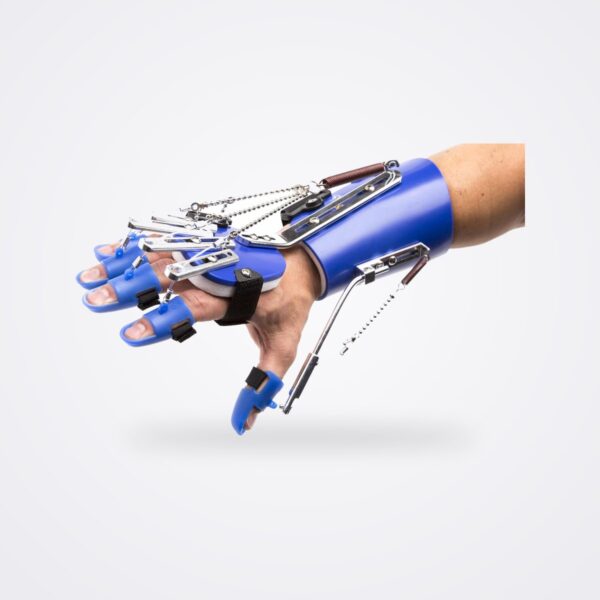
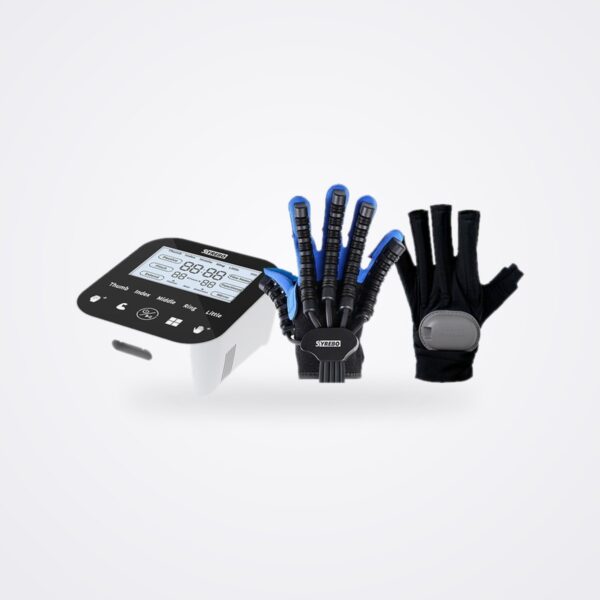
Hand of Hope is worn on the back of the impaired hand, with two surface EMG sensors on the forearm extensor and flexor muscles. When the patient's voluntary signal crosses a threshold set by the therapist, motors assist the fingers to open or grasp, so movement starts from the patient's own intention. Training modes range from continuous passive motion to EMG-triggered and EMG-maintained exercise, and interactive games keep patients engaged. No electrical current is applied to the patient.
Key specifications
Why the Hand of Hope
Movement starts with the patient
The robotic hand waits for the patient's own EMG signal before it assists, so each repetition begins with voluntary effort rather than passive motion.
Therapist-set challenge
Therapists set the EMG threshold and choose between continuous passive motion, Trigger & Go and Trigger & Maintain, raising difficulty as control improves.
Games that motivate
Five interactive games train opening, grasping and coordination; higher levels add arm movement to complete the tasks.
Progress on record
Each patient's settings and training sessions are stored and can be recalled, with graphical results for progress reviews.
Where it is used
Hospital and outpatient neurorehabilitation, stroke units, occupational therapy and physiotherapy departments, and rehabilitation centres.
In the box
Hand of Hope hand brace(s) in the ordered size and side, EMG sensors and control unit; the box set (HOH4-BOX SET-W) bundles multiple components. Exact contents per configuration were not published. Pack sizes and configurations are confirmed with the quotation.
Clearance & compliance
CE marked: EUDAMED lists Hand of Hope HOH4 models as Class IIa, on the EU market (manufacturer SRN HK-MF-000040022, authorised representative MedNet EC-REP GmbH); EC certificate shown on rehab-robotics.com.hk · FDA: registered and listed by Rehab-Robotics Company Limited, product code BXB (powered exerciser), Class I, 21 CFR 890.5380, no 510(k) · Health Canada MDAL, Taiwan and Hong Kong listings shown by the maker. Supplied subject to registration in each destination country (MOHAP, DoH, DHA, SFDA or the equivalent authority). Certificates, declarations of conformity, IFUs and registration documents are provided with every quotation. Specifications are indicative and subject to manufacturer change.
Where a country has an official agent or authorised distributor, we source the item through it — or directly from the manufacturer if necessary. Product names, trademarks and images belong to their respective owners.
Questions
Is the Hand of Hope available in the UAE and the GCC?
KGG sources the Hand of Hope on request for hospitals and rehabilitation centres in the UAE, Saudi Arabia, Qatar, Kuwait, Bahrain and Oman. It is supplied subject to registration in each destination country, and availability is confirmed with each quotation.
How do I get a price?
Add it to your quote list or use Request a quote. We reply with pricing, lead time and the documents for your country, with the brace sizes and sides you need.
Does it use electrical stimulation?
No. The sensors only read the patient's muscle signals; the motors move the fingers once the signal crosses the threshold set by the therapist.
Which patients is it suitable for?
Patients with reduced hand function after stroke, spinal cord injury or hand and finger injury. It is not suitable for rigid finger contractures, spasticity above 3 on the Modified Ashworth Scale, open wounds or hand deformity.
What sizes are available?
Small-to-Medium and Large braces for left or right hands, with internal platforms chosen by hand width from 88 to 130 mm.
Request a quote
Get pricing for the Hand of Hope.
Tell us the quantity, delivery city and whether you are ordering for a facility, a team or a patient. We reply with pricing, lead time and the regulatory documents for your country.
 English
 العربية