
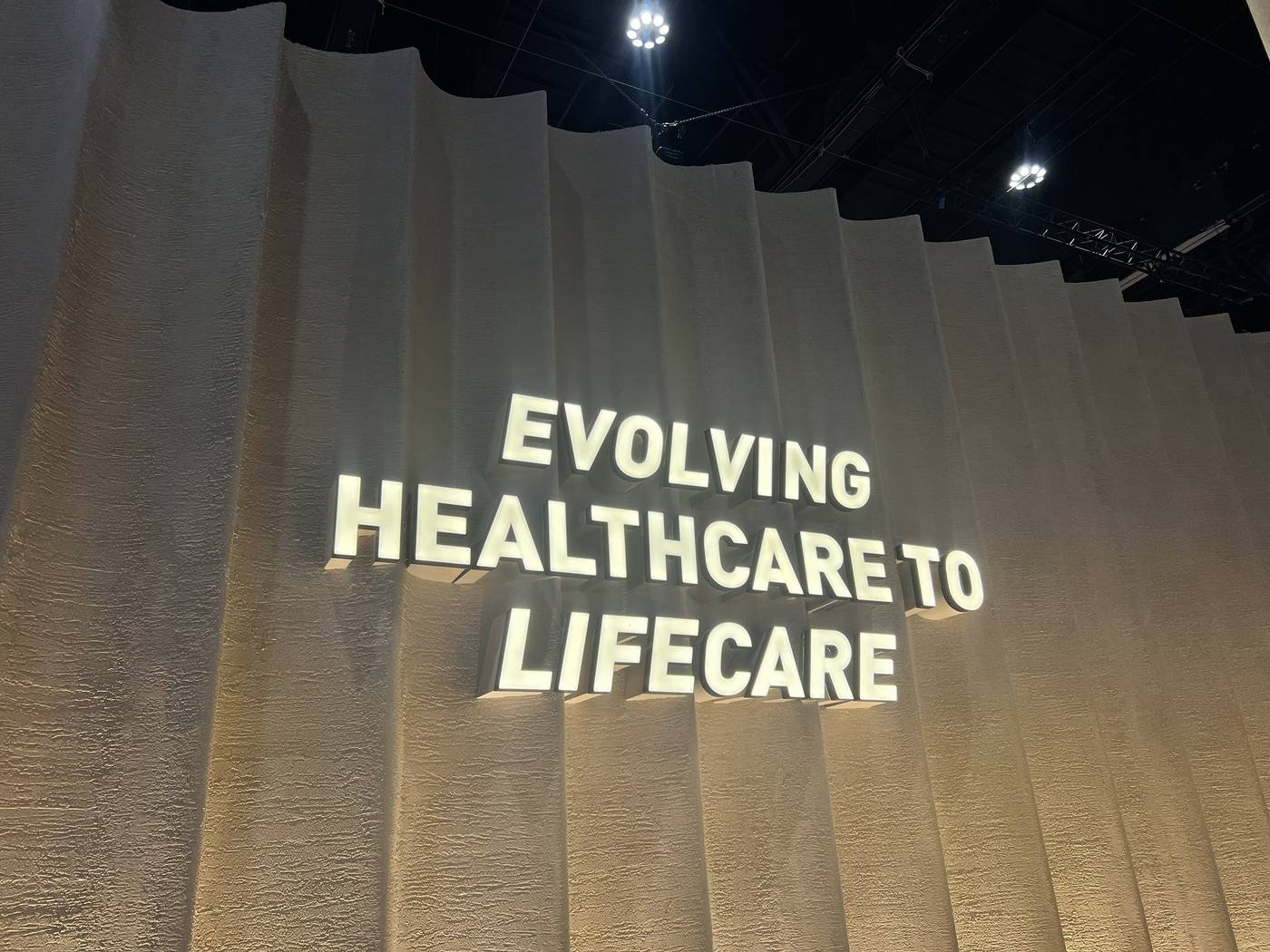
Future Health Summit 2026 · Abu Dhabi
Visitor passes are free and issued by the organiser. To meet KGG’s leadership team at ADNEC, request a time below.
Abu Dhabi will spend three days this week making the case that medicine should move upstream. The Future Health Summit 2026 runs from Tuesday 20 October to Thursday 22 October at the ADNEC Centre Abu Dhabi under the theme “To Sense is to Predict,” and the Department of Health – Abu Dhabi, which convenes it, says the goal is to move health systems from responding to illness to forecasting risk, according to the organisers’ statement of 2 October.
The scale is that of a trade fair with a policy agenda attached. The organisers list 300 speakers, more than 130 of them on the main Forum programme, more than 175 exhibitors and participation from about 100 countries; Gulf News reported that around 16,000 international participants and 1,750 conference delegates are expected. The summit is held under the patronage of Sheikh Khaled bin Mohamed bin Zayed Al Nahyan, Crown Prince of Abu Dhabi, and is the flagship of Future Health, the year-round platform that replaced Abu Dhabi Global Health Week in 2025.
Why it matters
Abu Dhabi is not hosting a conference about predictive medicine so much as demonstrating a product. The emirate has assembled, in one jurisdiction, most of what the thesis requires: a population genome programme, a unified health information exchange in Malaffi, a national biobank, and two large state-linked operators, PureHealth and M42, that can put new tools into clinical use at scale. The summit is where that package is shown to ministers, regulators and investors from Africa, Europe, Asia and Latin America, and where the pharmaceutical and device industry comes to be seen alongside it. “The next chapter of health will be defined by our ability to act earlier,” Dr Noura Khamis Al Ghaithi, Undersecretary of the Department of Health – Abu Dhabi, said ahead of the event.
For anyone who sells into Gulf hospitals, that matters in a practical way. The language used on stage this week becomes the language of tenders next year. Three editions ago the vocabulary was beds and equipment; it is now data, sensing and prediction.
The stage, the money and the dissent
The Forum mixes pharmaceutical chief executives with wearables founders and health ministers. Confirmed names include Sir Pascal Soriot, chief executive of AstraZeneca; Tim Schmid, executive vice president and worldwide chairman of Johnson & Johnson MedTech; Max Jaderberg, president of Isomorphic Labs; Will Ahmed of WHOOP; Tom Hale of ŌURA; Matteo Franceschetti of Eight Sleep; Elena Bonfiglioli, who leads healthcare, pharma and life sciences at Microsoft; Sir Martin Evans, Nobel laureate in medicine; Helga Fogstad, Director of Health at UNICEF; and Mansoor Al Mansoori, Chairman of the Department of Health – Abu Dhabi. Health ministers from Egypt, Armenia, Montenegro, Kosovo and Colombia are on the programme, as is Dr Fatima Al Kaabi, Director General of the Emirates Drug Establishment.
The money is local. PureHealth, M42, the Institute for Healthier Living Abu Dhabi and Mubadala Bio are founding partners; Mediclinic Middle East is strategic partner and Burjeel Holdings associate partner. The published exhibitor list runs from Mayo Clinic, Mass General Brigham, Penn Medicine and Cleveland Clinic Abu Dhabi to Amgen, Viatris, Insilico Medicine and Khalifa University, with Abbott, Eli Lilly, Novo Nordisk, Pfizer and McKinsey & Company among the sponsors. M42 alone fields nine executives across the three days, from Group CEO Dimitris Moulavasilis to Malaffi CEO Kareem Shahin, according to its event page.
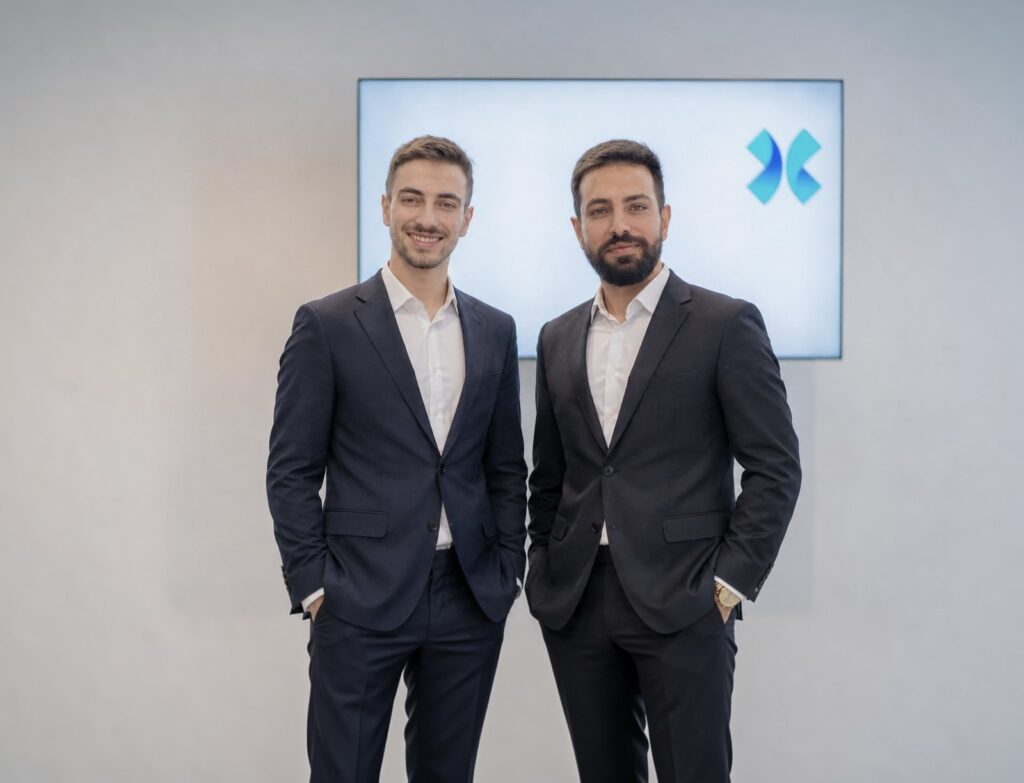
The supply side of the region’s health system is also on the programme. Khair Tamimi, Founder and Managing Director of Kanan General Group (KGG), an Abu Dhabi-based distributor of medical equipment and health IT, speaks on what it takes to connect independent clinics to predictive health systems. His is a less comfortable message than most, because it concerns the part of the system the founding partners do not run.
The last mile of sensing
The summit’s organisers describe sensing at three levels: population, through risk forecasting and disease-pattern surveillance; system, through integrated risk stratification and genomic screening; and individual, through behavioural pattern recognition and data-driven lifestyle support. Every one of those depends on data arriving from the point of care, and in medicine the richest stream of that data is imaging. A model cannot forecast cancer risk from a CT scan that sits on a departmental server in a clinic that archives locally and hands the patient a CD. It cannot learn from an ultrasound that never reaches the health information exchange.
The large operators that fund the summit are wired for this. A substantial share of the region’s imaging, however, is performed in small and medium clinics, many of them single-site, that are not, and that is where Tamimi’s argument begins.
A health system cannot predict from data it never receives. The barrier for the independent clinic is commercial, not technical. It will not buy a five-figure licence and a three-year implementation. It will buy pay-per-use, hardware and software under one contract, its old data migrated for it, and exchange-readiness built in from day one. That is the last mile of sensing, and distributors are the ones walking it.
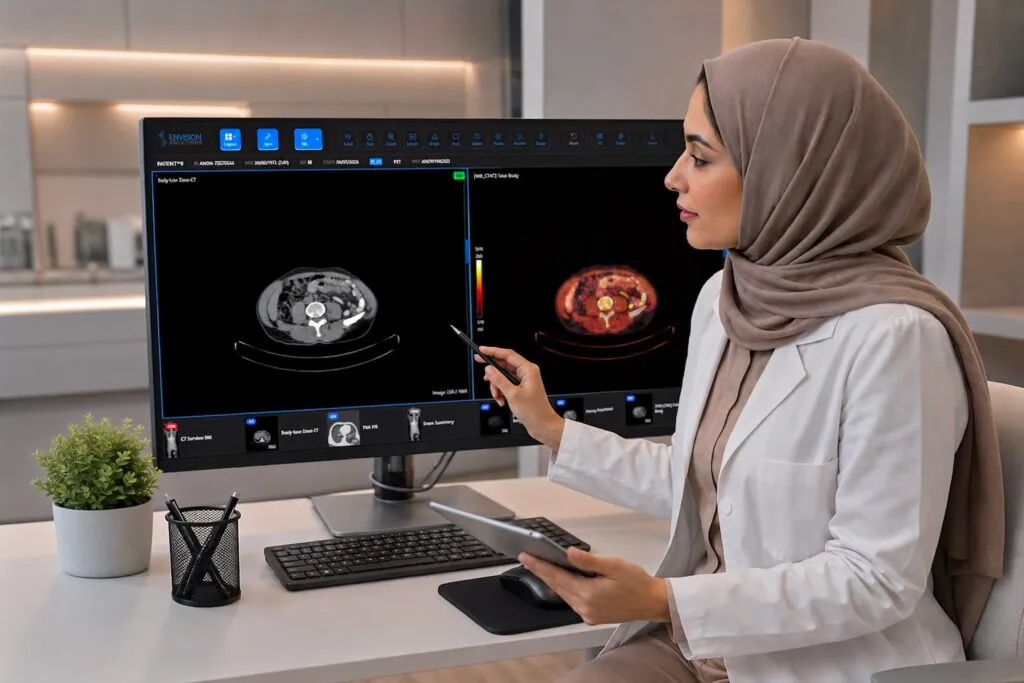
KGG works on that layer. It holds exclusive GCC rights to Envision, a cloud-native radiology information system with hybrid PACS and a zero-footprint DICOM viewer, offered on a pay-per-use basis and built for health-information-exchange readiness, and it supplies imaging, point-of-care and portable medical devices to hospitals and clinics across the region. The company’s view, formed in procurement rooms rather than on conference stages, is that the connective work between a vendor and a small or medium clinic, the registration, the data migration, the training, is done by nobody if the distributor does not do it.
The point has a direct bearing on what Abu Dhabi is trying to export. Future Health says it will publish blueprints from the emirate’s experience in six areas, including genomics, cancer and rare diseases, for other health systems to adopt. Blueprints travel only as far as the infrastructure that can run them. Tamimi’s ask of the room is that the blueprints describe the independent sector and the connective layer, not only the flagship systems, because in the Gulf’s largest hospital markets, Saudi Arabia and the UAE, followed by Qatar, Kuwait, Oman and Bahrain, small and medium clinics far outnumber the large hospital groups.
The summit by the numbers
Three days, 20 to 22 October 2026, at the ADNEC Centre Abu Dhabi, open from 07:00 to 18:00. Three hundred speakers, of whom more than 130 sit on the Forum programme. More than 175 exhibitors and participation from about 100 countries, by the Department of Health’s count on 2 October; around 16,000 international participants and 1,750 conference delegates, by Gulf News’s. The organisers say more than three-quarters of the audience are C-suite decision-makers, a claim worth reading as a sales pitch to sponsors rather than a census. The inaugural Future Health Challenge drew 393 entries from 68 countries and paid out US$300,000 in prizes.
The programme moves from AI and multi-omics on day one, to bringing genetics into routine clinical care on day two, to precision oncology and longevity on day three, closing with an investment panel, “The Investment Lens: Banking on Prediction,” moderated by Rachel Pether of the Sovereign Wealth Fund Institute. The three winners of the inaugural Future Health Challenge, run with MIT Solve, attend as proof of concept: ThinkMD of Australia, whose clinical decision-support software is used by more than 9,000 frontline health workers, took the US$200,000 prize; Huna of Brazil and Vector Control Innovations of the United States received US$50,000 each, the Abu Dhabi Media Office reported in May. All three, notably, are tools for the frontline rather than the flagship hospital.
What executives should take from the week
For a hospital group or a ministry, the lesson is that the sequence matters: wire the data layer before buying the prediction layer. A predictive-health contract signed before imaging and device data are cloud-native and exchange-ready buys a model with nothing to read.
For an independent clinic, the economics have shifted in its favour. Cloud radiology and PACS no longer require capital expenditure or a dedicated IT team; the realistic path is a pay-per-use platform with the vendor carrying migration and integration, which puts a 20-bed facility on the same data grid as a tertiary hospital.
For suppliers and distributors, the signal from ADNEC is that the tender is changing shape. The buyers who will be invited back are those who can deliver the connective layer, hardware and software together, registered, integrated and supported, rather than a product alone.
Abu Dhabi has turned a health week into a standing export: a predictive-care model, backed by state-owned operators and now marketed to governments on four continents. The industry is showing up in force because the emirate is both a buyer and a reference customer. The model’s real test, though, is not in the Forum but in the thousands of small and medium clinics across the Gulf and the countries that will adopt the blueprints. Whether they can sense anything depends on whether someone connects them, and that, more than any keynote, is the business to watch this week.
Meet KGG’s leaders at the summit
Book a private meeting with Khair Tamimi and KGG’s leadership team at ADNEC, 20–22 October. Tell us what you would like to discuss, and we will confirm the time and meeting point by email.
- Choose a day and a topic
- KGG confirms the time and meeting point
- Meet the leadership team at ADNEC
Your request has reached us
KGG's team will email you to confirm the time and the meeting point at ADNEC. A copy of your request is in your inbox.
 English
 العربية